




– Sanjana Patra
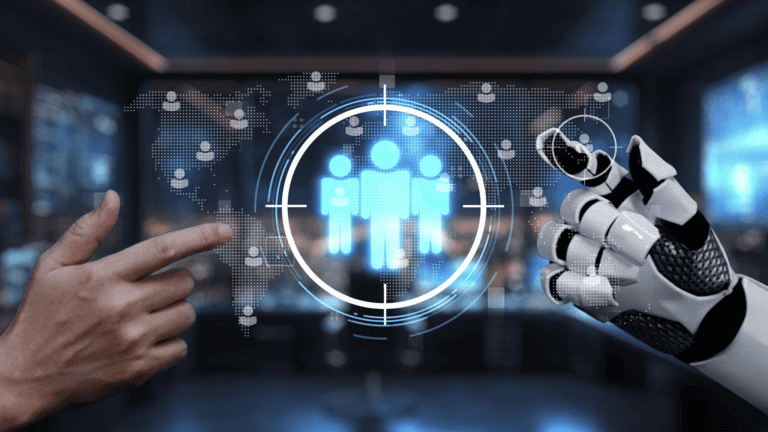
Hiring in tech is becoming more competitive and moving faster than ever. Recruiters are reviewing more CVs, filling roles under tighter timelines, and competing for a limited pool of highly skilled talent. To keep up, many teams now rely on AI-powered tools, and they work. AI reduces manual tasks, speeds up screening, and highlights patterns humans might miss.
But one thing is becoming clear:
“AI alone doesn’t build great teams.”
The companies succeeding today are the ones combining smart technology with something only humans can offer – “Emotional Intelligence”.
➤ Why Does Emotional Intelligence Still Matter?
Emotional intelligence (EI) is a practical skill, not a “soft” one. In recruitment, it appears when recruiters notice nervous candidates, understand real salary concerns, and realise when someone simply needs clarity. Technical skills can be tested, but motivation and cultural fit are assessed through human connection. A recruiter who builds trust keeps strong candidates engaged, which is often the deciding factor.
Research confirms that EI directly influences applicant satisfaction, acceptance rates, and long-term retention. When candidates feel heard, trust is established, and they are more likely to accept an offer. While AI can automate tasks and scan resumes, it lacks empathy and cannot evaluate human motivation. Algorithms streamline sourcing, but emotionally intelligent recruiters predict future success and ultimately secure the hire. Human connection remains a critical competitive advantage.
➤ Where Smart AI Makes the Biggest Difference?
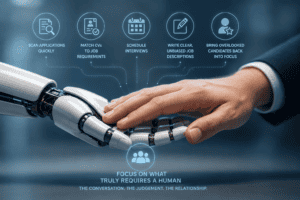 AI is most powerful when it removes friction, not humanity. In recruitment, that looks like quickly scanning hundreds of applications, matching CVs to real job requirements, scheduling interviews without back-and-forth emails, and bringing overlooked candidates back into focus. Paperwork can be automated, but the conversation, judgment, and relationship require a human. A recruiter freed from administrative tasks can focus entirely on the person, which is often the deciding factor.
The core principle is that AI should support decisions, not replace them. When recruiters have more time to focus on what truly requires a human, trust is established, and candidates feel valued from the start. While AI can write clear, unbiased job descriptions and automate workflows, it cannot replace human engagement. Algorithms streamline friction, but focused recruiters who meet candidates without distraction ultimately secure the hire. Leveraging AI to prioritise human connection is a critical competitive advantage.
“AI should support decisions, not replace them.”
By the time a recruiter meets a candidate, their attention should be on the person, not the paperwork.
➤ The Risk of Relying Too Much on One Side
Problems appear at both extremes.
Over-automating hiring
When recruitment relies too heavily on automation, the process feels cold and impersonal. Old data biases can quietly repeat themselves, leaving candidates feeling processed instead of valued.
Over-reliance on intuition
Conversely, when teams rely entirely on intuition, screening becomes slow and inconsistent. Personal biases inevitably influence decisions, which can lead to strong candidates being overlooked.
The real challenge comes when teams treat AI and EI as opposites. They’re not. They work best together.
➤ How HR Teams Can Get the Balance Right?
The most effective approach is simple:
Let AI handle the heavy lifting of sourcing, screening, and scheduling, while humans manage the nuanced work of interviews, offers, and sensitive conversations. To make this work, recruiters must be trained to interpret AI insights rather than follow them blindly, and a human should be accountable for every important decision. Transparency matters: candidates trust the hiring process more when they understand how AI is used and know a real person remains in charge.
Industry research agrees:
AI is great at sorting data but poor at reading people. Relying on algorithms without human oversight can easily repeat past hiring biases. Ultimately, AI should act as a smart assistant, while actual hiring decisions and the empathy required to make them must remain entirely human.
➤ A New Way Forward in Tech Hiring
As tech recruitment accelerates, the most successful teams won’t be those with the most automation or the most intuition. They’ll be the ones who intentionally blend both.
AI helps you move faster. Emotional intelligence helps you choose wisely. Hiring was never meant to be a competition between humans and machines.
“It’s a partnership and the teams that get this balance right will hire better, build stronger relationships, and retain great talent long after the offer is signed.”
————————————————————————————————-
Copyright © Softest Consulting Services Limited
